2003-2004KM/H
KM/H (2003–2004) — Screensaver, Generative Online Video Film
KM/H questions the very notion of the artwork online by shifting it toward a regime of appropriation and propagation. The web is no longer conceived as a conventional space of distribution, but as a simple point of access to a device that users are invited to download and install onto their own computers.
This act of installation already produces a first transformation: the work leaves the centralized flow of the network to enter a logic of dispersion, cloning, and anonymous multiplication. Each copy becomes a singular instance, part of a wider, decentralized ensemble where the work propagates while remaining directly linked to each local situation of appearance.
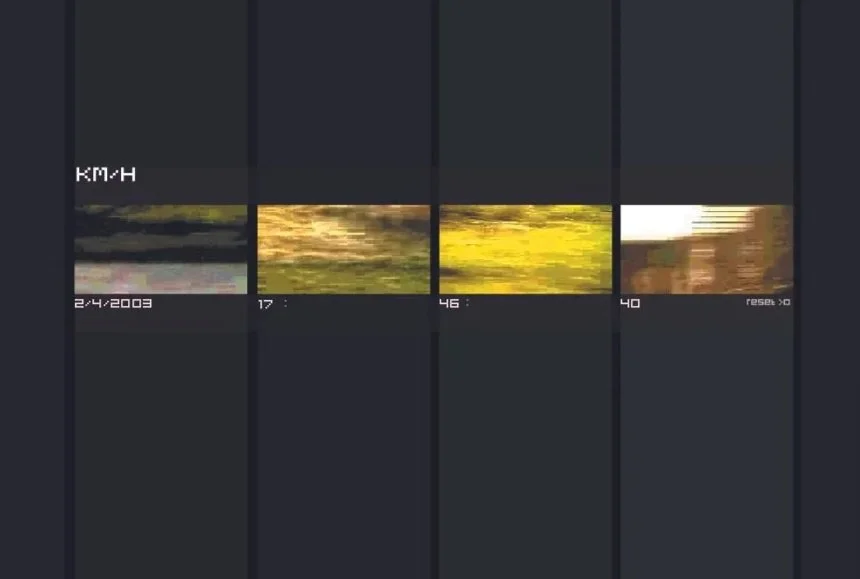
The images of KM/H were filmed from a moving car travelling between Grenoble and Valence. Fragmented landscapes, road infrastructures, urban edges and fleeting lights unfold across four synchronized screens in heavily pixelated color. These images do not seek documentary precision. Reduced to unstable flows of chromatic vibrations, they become moving perceptual fields — “colored palpitations,” echoing the words spoken by Jean-Paul Belmondo reading Élie Faure in Jean-Luc Godard’s Pierrot le fou: “never again a defined thing.”
The sound composition is built from rhythmic samples triggered according to the internal clock of the computer running the work. Seconds, minutes, hours and temporal cycles become active compositional structures integrated into the very behavior of the piece. Voices emerge, disappear and return in shifting combinations: fragments from Godard — “Cinema is nothing more than this: making two people speak together and hearing nothing” — excerpts from Gilles Deleuze reflecting on the refrain, auto-movement and auto-temporalization, as well as a phrase by Toni Negri: “When the body is imprisoned, the mind no longer exists.”
KM/H thus proposes a form of cinema without fixed duration. It unfolds neither through beginning nor ending, but through continuous variation. Image and sound perpetually recombine according to the temporal activity of the machine itself. The work becomes a living process rather than a stable object: an autonomous system generating its own successive states.
This research already contains, in manifesto form, many of the principles that would later structure Denis Vedelago’s generative films: moving montage, non-linear narration, repetition and difference, the image as flux, and the artwork as an unstable organism evolving through time.
Each manifestation of KM/H is therefore unique, inscribed within a specific technical and temporal context. The work never repeats itself identically; it drifts, mutates and reconfigures itself according to its environment of execution.
Once downloaded and installed, the piece was designed to disappear automatically after one year, introducing a dimension of programmed obsolescence and finite temporality, reinforcing the idea of the artwork as process rather than archive.
Concept and realisation: Denis Vedelago — Programming: Gregory Lasserre